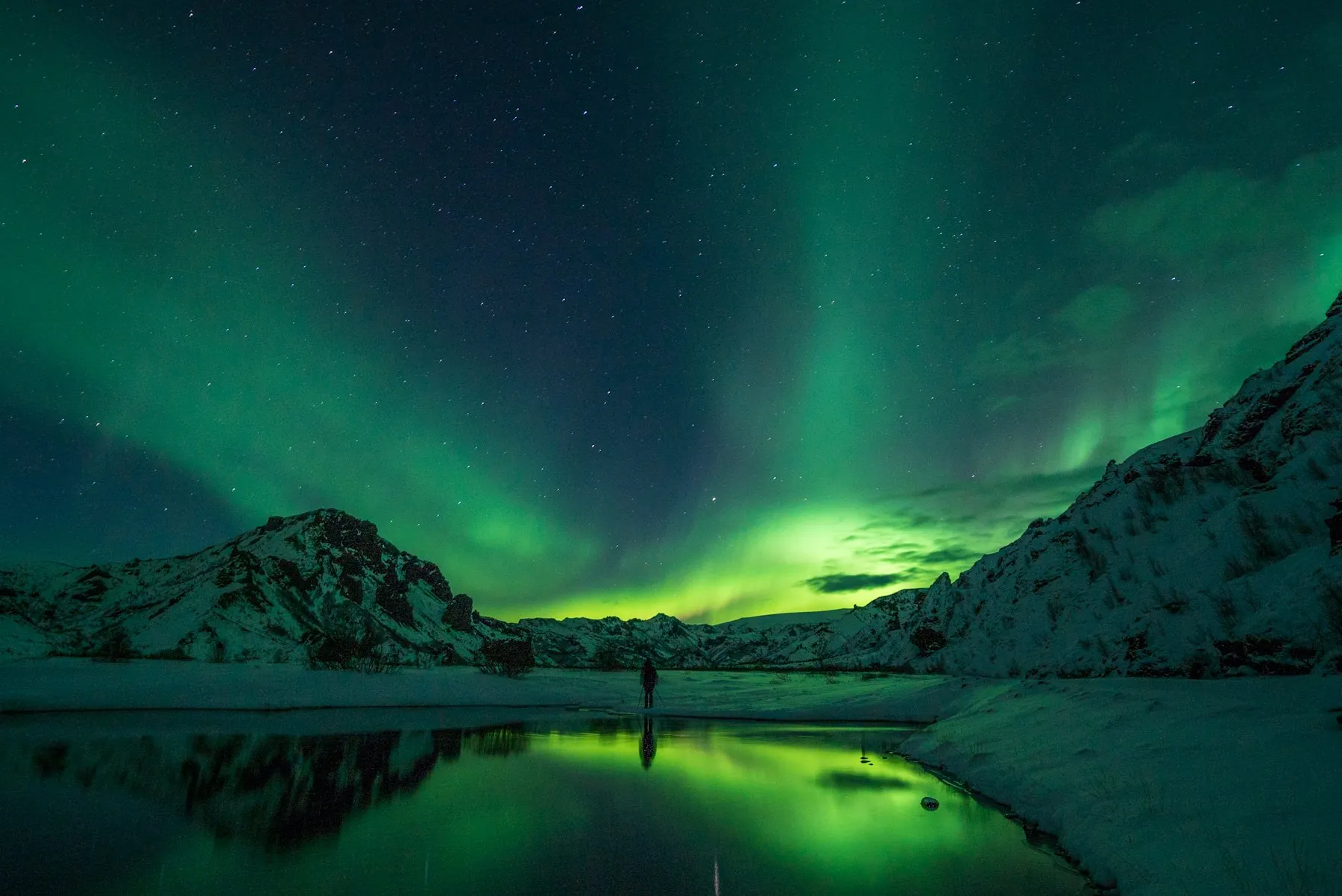
Space Weather and Other Sensors
Underneath the auroral oval - one of the best places for monitoring space weather
An ever-increasing proportion of global GDP now depends on space-enabled technologies that are vulnerable to space weather - Earth observation (EO), telecoms and positioning, navigation and timing (PNT). Amongst the developed nations this can amount to 5-10% of the economy.
- Latitude
- 65.65°N, under the auroral oval
- Magnetic conjugate
- Syowa Station, Antarctica
- Longitude gap filled
- Between IMAGE/EISCAT and Greenland
- Radio environment
- 75% of people in three towns, no railways
Benefits for weather monitoring
Iceland is one of the best places in the world for monitoring space weather.
| Directly under the oval | In Iceland your instruments are right under the auroral oval giving you direct observation of auroral, solar and cosmic ray activity in the upper atmosphere. |
|---|---|
| North Atlantic HF Comms | As space is increasingly militarised, satellite communications become increasingly vulnerable to disruption and the HF comms used as a backup become increasingly important. An ionosonde, riometer, Global Navigation Satellite System (GNSS) scintillation receiver and magnetometer could together give real time HF and GNSS conditions for the North Atlantic. |
| Plugs a longitude gap | Monitoring stations in Iceland would interpolate between Scandinavian monitoring networks (EISCAT, IMAGE) and equipment in Greenland and Canada. |
| Magnetic twin with Antarctica | As the earth's magnetic field is tilted with respect to lines of longitude, the Syowa monitoring station in Antarctica is at the opposite end of the same magnetic field line making it easy to compare the two hemispheres. |
| RF Quiet Monitoring | 75% of Iceland's population lives around the three largest towns Reykjavik, Keflavik and Akureyri. There are no railways and there is little industry making Iceland a very radio quiet country. In winter, there is very little light pollution which suits all-sky aurora cameras. |
| Benefit to Iceland | HF disruption and GNSS scintillation can affect not just Iceland's aviation and shipping, but also Iceland's power grid and hence its large aluminium smelters. All three of Iceland's biggest industries are directly affected by space weather. |
| Efficient Regulatory Regime | Chirp sounders and ionosondes both require licensing by Fjarskiptastofa. Iceland's lightweight regulatory regime means that this can be done swiftly and at relatively low cost. |
Read this first
The fastest way to establish whether we are worth your time.
Clouds and sunshine
Mean cloud cover is around 75%, and there is no astronomical darkness from early April to early September. For all-sky cameras and other optical sensors this is unlikely to be ideal.
Site restrictions
We are very careful how we arrange customers on our primary site so as to preserve their lines of sight and minimise RF crosstalk between them. For space weather instruments which may be tall or particularly sensitive to RF interference, subsidiary sites may be more suitable and these are not so well equipped with power and internet access.
Next step
Tell us the sensor you have in mind.
Tell us what you have in mind and we will use our local knowledge to advise on feasibility and appropriate locations. Many instruments can be hosted at our Reykjanes or Blönduós sites. Others would be better situated away from potential RF interference.